by Dale Henwood GBHA Advisory Council
1.0 Background/Overview
As detailed in the previous 2 parts of this article, the 2025-2026 season witnessed an historic philosophical change related to player compensation, forced upon the NCAA by the courts. Not just that they are now eligible – as they were not for 50 plus years. But also, there may be significant financial value attached to the players that move although contract amounts are typically private and not publicly disclosed.
The impact of new NCAA rules on college hockey, particularly focusing on NIL (Name, Image, Likeness) deals and their effects on player recruitment and retention. They explored how schools are navigating these changes through alumni donations, collectives, and endowments These financial shifts are affecting both NCAA and Canadian universities, with U SPORTS and Tier 2 junior leagues potentially facing the most significant challenges. They also discussed the changing landscape of junior hockey, noting how CHL players are increasingly being recruited by NCAA schools, and how this could impact the future of both leagues.
2.0 A Changing Landscape
There has been a massive shift in the nationality of NCAA players.

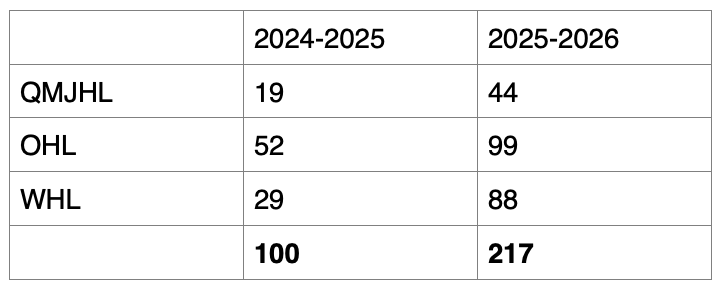
As of January 10, 2026, 199 CHL players are scheduled to leave the CHL for NCAA D1 hockey in 2026-2027 all with CHL eligibility remaining (NCAA and CHL Recruiting Battleground Tracker — The Dan K Show). An additional 84 players are committed to flip for the 2027-2028 season.
These numbers will climb and it seems leaving the CHL early is the new norm. This has an enormous impact on U SPORTS as these players so south. Traditionally, many would have joined U SPORTS once their CHL eligibility expired. This year there are more Americans in the CHL.
3.0 Immediate Impact
a. CHL-NCAA Agreement
There will need to be an agreement between the NCAA schools and the CHL as currently, NCAA schools are freely poaching 18- and 19-year-old players (still with CHL eligibility) during the season. There is a need for a new, respectful relationship agreement to be developed between CHL and NCAA teams.
The NCAA schools now offer an academic opportunity for players not ready to turn pro. Players on the new Standard Player Agreement (SPA) must play in the WHL up to and including their 19-year-old season to receive their full scholarship benefits. This applies to players drafted and signed as of May 2025. Current WHL players on the old SPA are still eligible to receive their scholarship benefits if they sign with NCAA schools.
b. New recruiting approaches
The Golden Bear program, historically, has been among the best, if not the best, in Canada in recent years. Other programs have modelled their approach after the Bears, and have for all intents and purposes, caught up with the Bears. The new “attack from the NCAA” and their poaching philosophy backed by the new rules adopted by the NCAA necessitates new recruiting practices.
For specific examples see 7.0.
c. Economics
Recently, NCAA athletes began to earn two new forms of compensation. One source is from NIL opportunities as noted above. The other is through Alston awards, which are education-related, financial awards provided directly by universities that could total roughly $24,000 during a four-year college career. Alston awards can provide athletes with up to $5,980 annually and although these awards do not receive the same media attention as NIL deals, but they could prove to be even more financially lucrative for a greater number of Division I athletes and are now being used as part of an athlete retention strategy.
4.0 Long Term (Economic) Impact
There will be long term economic impact on academic programs. For example, in particular for football and basketball, the University may have received upwards of $20M in jersey revenue. This money now goes to the athlete(s) based on the NIL rules. That means the other University programs or University operations that previously received those funds are now going to be squeezed as those dollars are no longer available to the greater University.
Programs will need to create hockey specific endowments that provide longevity. Today much of the Alumni funds go to support day to day operations. Endowments offer an opportunity to re-engage Alumni or further engaged already committed Alumni.
5.0 Collectives
As was explained in Part 2 of this series, when NIL became legal, individual athletes suddenly had to navigate contracts, taxes, brands, and compliance. Boosters/Alumni stepped in to create collectives that:
- Organize NIL opportunities
- Handle logistics and payments
- Ensure deals meet legal and NCAA requirements
- Keep their school competitive in the talent marketplace
In practice, collectives became the primary source of NIL income for many athletes.
NCAA rules still prohibit:
- Pay‑for‑play (paying someone just to be on the team)
- Recruiting inducements (promising money to sign or transfer)
- Guaranteed salaries disguised as NIL deals
- Undisclosed or secret agreements
These lines are blurry in practice, which is why collectives are at the center of many disputes and lawsuits. Collectives are now the dominant financial engine shaping:
- Recruiting and retention
- Donor engagement strategies
- Competitive balance
- Athlete branding and legacy-building
They have essentially become the new booster arms race, replacing the old under‑the‑table system with a semi‑regulated one.
6.0 Role of Alumni
A University hockey alumni association plays a vital stewardship role by fostering lifelong connections between former student-athletes, the current program, and the broader university community. It preserves and celebrates the team’s history and traditions, provides mentorship and networking opportunities that support the personal and professional development of current players, and serves as an advocacy and fundraising body to enhance competitive excellence and student-athlete experience. Through engagement, recognition, and philanthropy, the alumni organization helps ensure longevity and sustainability, culture, and reputation of the hockey program while reinforcing alumni pride and loyalty to the institution.
Too often the primary focus when engaging alumni is on revenue generation and fund raising. Although important, consistent financial asks can not be the sole method to engage alumni and seek their support. Beyond fundraising, a well-structured alumni association can be a strategic asset to a university hockey program. Its value lies in strengthening the program’s culture, competitiveness, and long-term sustainability. Key roles could include the following:
1. Mentorship and Player Development
Alumni can provide structured mentorship to current student-athletes, offering guidance on career planning, life after hockey, leadership, and balancing academic and athletic demands. This is particularly valuable in an era where only a small percentage of players advance to professional hockey.
2. Career Networking and Employment Pathways
Alumni associations can facilitate internships, job shadowing, and employment opportunities for graduating players. This reinforces the university’s value proposition to recruits and their families by demonstrating a tangible commitment to post-graduation success.
3. Program Advocacy and Reputation Building
Engaged alumni serve as ambassadors for the program within their communities and industries. Their voices carry credibility when advocating for institutional support, facility upgrades, or broader recognition of the program’s impact on campus and in the community.
4. Recruiting and Retention Support
While alumni should not be involved in impermissible recruiting activities, they can play a powerful role in storytelling—sharing authentic experiences that reinforce program culture, tradition, and academic excellence. Alumni engagement can also help current players feel more connected, reducing transfer attrition.
5. Preserving and Celebrating Program History
Alumni associations are natural custodians of a program’s legacy. They help document history, recognize milestones, and honor former players and builders, reinforcing pride and continuity across generations of athletes.
6. Game Day Atmosphere and Fan Engagement
Organized alumni participation enhances attendance, energy, and visibility at games. Alumni nights, reunions, and community events create a stronger home-ice advantage and deepen the emotional connection between the program and its supporters.
7. Feedback and Strategic Insight
Experienced alumni can provide informed, constructive input on program direction, athlete experience, and emerging trends in university hockey. When properly structured, this feedback can support leadership decision-making without undermining governance.
8. Supporting Athlete Well-Being and Transition
Alumni can help normalize conversations around mental health, injury recovery, and career transitions by sharing lived experience. This peer-to-peer perspective often resonates more deeply than institutional messaging alone.
9. Strengthening University Alignment
A strong Alumni Association helps position the hockey program as an integrated part of the broader university mission—academic excellence, leadership development, and community impact—rather than as a standalone athletic entity.
In short, Alumni Associations contribute to competitive advantage, cultural strength, and athlete outcomes. When aligned with athletic department leadership, their impact can be transformational, not transactional.
10. Fundraising
The Alumni Association can play a central facilitation and leadership role in the creation of endowments by cultivating relationships, inspiring philanthropic intent, and connecting alumni donors to the program’s long-term priorities. It works in close partnership with the university’s advancement and development teams to identify potential benefactors, articulate the impact and purpose of endowed funds, and steward donors throughout the giving lifecycle. By communicating a compelling case for support, recognizing donor contributions, and ensuring ongoing engagement and transparency, the Alumni Association helps transform alumni affinity into permanent, sustainable funding sources that support scholarships, program enhancements, facilities, and the enduring mission of the hockey program.
So, there will be an important role for U SPORTS team alumni in this new era. Based on investment returns from the endowments, the Alumni could cover extraneous costs that the hockey program can not cost – such as better travel conditions (fly versus bus), extra meals, better accommodation, and speciality services.
Hockey Alumni will become more “professional” in their approach, with staff and high profile (wealthy) Board of Directors offering:
- Career mentoring and career connections
- Fund raising
- Organization of special events
- Domain expertise for coaches
7.0 New Recruiting Strategies
Canadian university hockey programs are operating in a significantly altered talent recruitment ecosystem because of recent NCAA rule changes (the NCAA’s removal of the ban on Canadian Hockey League (CHL) players, expanded transfer flexibility (including unlimited transfers and easier movement via the transfer portal), and broader eligibility shifts — that have dramatically expanded the pool of players American Division I programs can pursue). These changes are accelerating what many describe as “poaching” of elite Canadian talent, particularly players who previously would have chosen U SPORT.
For Canadian university programs to remain competitive and continue attracting elite players, a re-imagined approach to recruiting is required — one that embraces both the opportunities presented by the new environment and the unique strengths of the U SPORTS system.
U SPORTS programs can no longer rely on tradition or education value alone. The competitive landscape has fundamentally changed. If Canadian programs want to keep elite players—and attract the next wave—they need to recruit like disruptors, not defenders of the status quo.
Below are some innovative and realistic recruiting options that Canadian university hockey teams have recently adopted or should consider adopting immediately. Disclaimer: These concepts were developed through discussions with senior executives in the CHL and NHL, combined with AI-supported analysis. Some initiatives are more feasible than others and several require meaningful new investment so are not applicable to all programs.
1.0 A Clear and Compelling Development Opportunity
1.1 Market a Clear Development Pathway
Many Canadian players and families perceive NCAA programs as the default route to professional hockey because of scholarship structures and visibility. U SPORTS teams must clearly define and communicate their unique development model, emphasizing:
- A highly competitive schedule.
- A balanced commitment to academic excellence and athletic performance. U SPORTS is to be viewed as a developmental investment in their career. Investing now for longer term career playing opportunities.
- Individualized coaching, player development plans and long-term career positioning.
U SPORTS should be positioned as a deliberate developmental investment—one that prioritizes both hockey longevity and post-hockey success. Emphasizing these can help neutralize the default appeal of NCAA offers.
1.2 Leverage Academic and Career Outcomes
Highlighting this dual pathway — strong education plus high-performance hockey — differentiates U SPORTS from NCAA environments that, while prestigious athletically, may not match all academic offerings.
1.3 Build a Canadian NIL Identity
U SPORTS can not and should not try to match NCAA NIL spending dollar-for-dollar. Instead, it can offer something distinct and sustainable: community-embedded, locally loyal, long-term partnerships. This may include:
- Micro‑NIL opportunities with local businesses, alumni-owned companies, and local/regional sponsors.
- Athlete‑as‑ambassador programs tied to community engagement, youth camps, and brand storytelling.
- Structured summer employment pipelines tied to donors and alumni networks.
This approach aligns with Canadian values while providing tangible financial and experiential benefits.
2.0 Recruit With Data, Analytics and Personalization
Modern recruiting increasingly mirrors professional sports. U SPORTS programs must match that sophistication by adopting data-driven approaches, including:
- AI-supported scouting models to identify late bloomers, overlooked CHL players, and undervalued transfers
- Performance projection tools that illustrate how a recruit fits the program
- Personalized recruiting dashboards outlining projected role, usage, development curve, and professional comparables
These transform recruiting from a generic pitch into a customized, professional process.
3.0 Proactive Leverage Transfer Channels
3.1 Target NCAA Transfers Strategically
The NCAA transfer portal has created significant roster churn. U SPORTS can convert that instability into opportunity by:
- Actively monitoring the portal for players seeking increased playing time, leadership roles, or better academic alignment
- Preparing academic pathways that preserve credits and minimize disruption
- Positioning U SPORTS as the premier landing destination for dissatisfied NCAA athletes
If U SPORTS becomes the best landing spot for frustrated NCAA players, the talent flow reverses.
3.2 Provide Comprehensive Transition Support
To attract transfers, programs should offer structured onboarding, including academic advising, housing support, integration services, and clearly defined athletic development plans. This signals professionalism, a welcoming environment and reduces perceived risk for recruits.
4.0 Expand and Modernize Digital Recruiting
4.1 Dynamic Content and Virtual Engagement
Gen Z recruits expect programs to feel vibrant and accessible online. Effective strategies include:
- Behind-the-scenes documentary-style content (think: Formula 1 and Drive to Survive, but for your team).
- Player-led media (mic’d practices, vlogs, day-in-the-life features)
- Personalized digital recruiting kits and immersive virtual campus tours
4.2 Integrated Scouting and Analytics Platforms
Centralized digital systems that combine analytics, video, and standardized metrics enable earlier identification of high-potential players and provide objective comparisons between NCAA and U SPORTS opportunities.
Implement digital systems that aggregate performance analytics, highlight reels, and standardized metrics for prospects. This approach helps U SPORTS coaches:
- Identify high-potential players earlier.
- Provide objective comparison tools to athletes/families evaluating NCAA vs. U SPORTS options.
Using such systems signals professionalism and modern talent evaluation comparable to NCAA strategies.
4.3 Virtual Engagement and Content Marketing
Develop a structured virtual recruiting funnel, including:
- Short form highlight content tailored to player strengths.
- Regularly updated program videos and athlete testimonials.
- Coordinated social campaigns targeting prospective recruits (via Instagram, TikTok, LinkedIn, YouTube).
This supports visibility in spaces where athletes and families already are.
5.0 Create a “Pro-Ready” Development Environment
Elite players want to feel like they are stepping into a “professional” organization. Canadian universities can excel by leveraging campus wide expertise to provide:
- NHL-style player development departments (skills coach, skating coach, mental performance coach, nutrition, mental health).
- Wearable technology and performance monitoring and biometrics integrated into training.
- Individualized development plans shared during recruitment.
- Alumni mentorship pods—pair each recruit with a former player and a business contact.
This is a significant competitive advantage for U SPORTS and where Canadian programs can outperform many NCAA schools. U SPORTS programs can be seen as high-performance destinations.
6. 0 Strengthen Program Identity, Culture and Alumni Networks
6.1 Culture and Brand Story
Strong branding wins hearts before facilities win minds. Programs should emphasize legacy, alumni success, and community impact through emotional storytelling and inclusive recruiting language that highlights belonging. Players want to feel part of something bigger than themselves.
6.2 Alumni and Career Networks
Develop robust alumni engagement and mentorship programs that connect current players with former athletes in professional hockey, business, or academic leadership. This reinforces long-term value beyond the rink and strengthens recruiting credibility.
7. 0 Treat Families Like Strategic Stakeholders
Parents are more involved than ever in decision-making. There should be a focus on educating families and prospects on system differences. What innovative family engagement might entail:
- Family onboarding sessions explaining academics, career pathways, mental health supports and eligibility nuances.
- Transparent comparative materials outlining costs, scholarships, academic support, and playing-time expectations relative to the NCAA.
- Webinars and regional information sessions for parents and coaches.
Trust and transparency are competitive advantages.
8.0 Expand the Recruiting Map and Develop Strategic Relationships
U SPORTS might consider new international markets. While Canadian and U.S. junior systems are key pipelines, looking abroad for elite players — particularly those seeking education — broadens the talent pool and differentiates the recruiting proposition. What this might entail:
High-performing players in provincial leagues.
- Europe (Sweden, Finland, Germany, Switzerland).
- U.S. Tier II leagues (NAHL, NCDC)
- NCAA DIII transfers
- CHL overagers looking for a second chance
- Dual-sport athletes with high athletic ceilings.
- Late developers who might be overlooked by NCAA recruiters focused on earlier evaluation windows.
Canadian universities can become the global destination for players who want both education and elite hockey.
8.1 Formal Partnerships with Junior Clubs and Recruit Beyond Traditional Pools
Build formal relationships with junior teams across Canada (OJHL, BCHL, MJHL and others) to:
- Offer academic tours and meet-and-greets with university staff and faculty.
- Create early dialogue channels so junior players view U SPORTS as an integrated next step, not a fallback.
These partnerships can offset the ease with which NCAA coaches currently contact prospects due to expanded eligibility pools.
9.0 Emphasize “Life After Hockey” as a Differentiator
This is the one thing the NCAA cannot match and remains a powerful differentiator. Recruiting should clearly answer the questions: What is the end game for the player? For example, at age 27, where will they live, what is the value of their degree? What this might entail:
- Career pipelines with alumni in law, business, engineering, medicine, technology.
- Guaranteed internships.
- Post-graduate scholarships for players who stay at the schools beyond their eligibility.
- Alumni mentorship networks that start on Day 1.
You are not just recruiting a player—you are recruiting a future professional in any field.
10.0 Build a Culture That Retains Talent
Recruiting is only half the battle. Retention is the new competitive frontier. A hallmark of the Golden Bears program has been the focus on character – players with humility, good solid citizens, that love the game, that are coachable, mature, not necessarily stars but are committed to the team. What this might entail:
- Leadership councils with meaningful influence.
- Player-driven culture frameworks (values, standards, accountability).
- Robust mental health and performance supports.
- Transparent role communication so players do not feel blindsided.
Retention is the most effective response to poaching.
Recruiting Summary:
The above suggestions come with other implementation considerations such as.
- It is essential to ensure recruiting practices comply with rules (provincial associations, U SPORTS) and maximize access to prospects.
- Ongoing tracking/measurement of recruiting outcomes, retention rates, and player satisfaction to iterate and refine strategies.
- Added resources are needed – especially with a digital focus and these require investment in staffing, technology, digital platforms and travel support.
To thrive amid NCAA expansion and increased competition, Canadian university hockey programs must adopt multi-dimensional recruiting models that emphasize a distinct value proposition, advanced analytics, digital engagement, strategic partnerships, and holistic athlete development. By doing so, U SPORTS can compete effectively for elite talent while reinforcing its unique strengths in education, development, and long-term career success.
8.0 The Future
The best guess is that it will take 3-5 years for the chaos to settle. It is expected that the top end dollars, although only available to very few athletes, will decrease and the lower end compensation will bubble up with endowments and Alumni support.
Top USA hockey programs (Michigan, Michigan State, Boston College, Boston University, Minnesota, North Dakota) will continue to attract top players but there will now be more competition for the players. Canadian universities with strong academic reputation across multiple disciplines (Alberta, McGill, Western, Queens, UBC, Calgary) will continue to appeal to CHL players and top players from other leagues. Recruitment and retention methods will continue to be the differentiator.
The transfer world is ravaging college sport. Players can transfer regularly but it is the same guy with a different address. The constant churn with players changing teams on an annual basis is not healthy for any team or league and will need to stabilize. Hockey has become a very expensive sport, and many (most) players are coming from families that have the resources to enlist in academies and sport specific schools. The pool of truly top players is diminishing due, primarily, to finances.
In the meantime, since big money is involved, there will be challenges and court cases. In a litigious state, United States, we can expect more of these to occur as money becomes a bigger factor and player choice is predominant.
For instance, a recent lawsuit where Football’s Missouri DE Damon Wilson II is suing the Georgia school’s athletic association, escalating one of the messiest player-school disputes of the NIL and transfer portal era. This sets up a landmark player vs. school NIL legal battle. (Missouri DE Damon Wilson II sues Georgia, setting up landmark player vs. school NIL legal battle – The Athletic).
Succinctly, “Wilson’s attorneys allege a civil conspiracy involving the Bulldogs and Georgia’s collective to try to “penalize Wilson for his decision to transfer.” The suit alleges that they interfered with his ability to enter the portal and lied about his NIL buyout. The former five-star recruit spent this season at Missouri.
The move is a counter to Georgia earlier seeking to go to arbitration to get $390,000 from Wilson, alleging damages after the player signed an agreement to return to Athens for his junior season before entering the transfer portal a month later”. A month after signing the deal, he transferred to Missouri. Because the agreement was contingent upon his staying at Georgia, the collective ended the deal.
It is also believed to be the first time a player and school have taken each other to court over an NIL dispute. As the player compensation space evolves in the first years of direct revenue sharing between schools and athletes, disputes will continue to arise. Whether contracts are binding is, to some degree, an open question and affects whether players can essentially function as free agents every year.
Where will this end up? Stay tuned…
